Google-Agent Is Here — And AI Agents Are No Longer Just a Developer Thing
Monk Mode Marketing
April 6, 2026
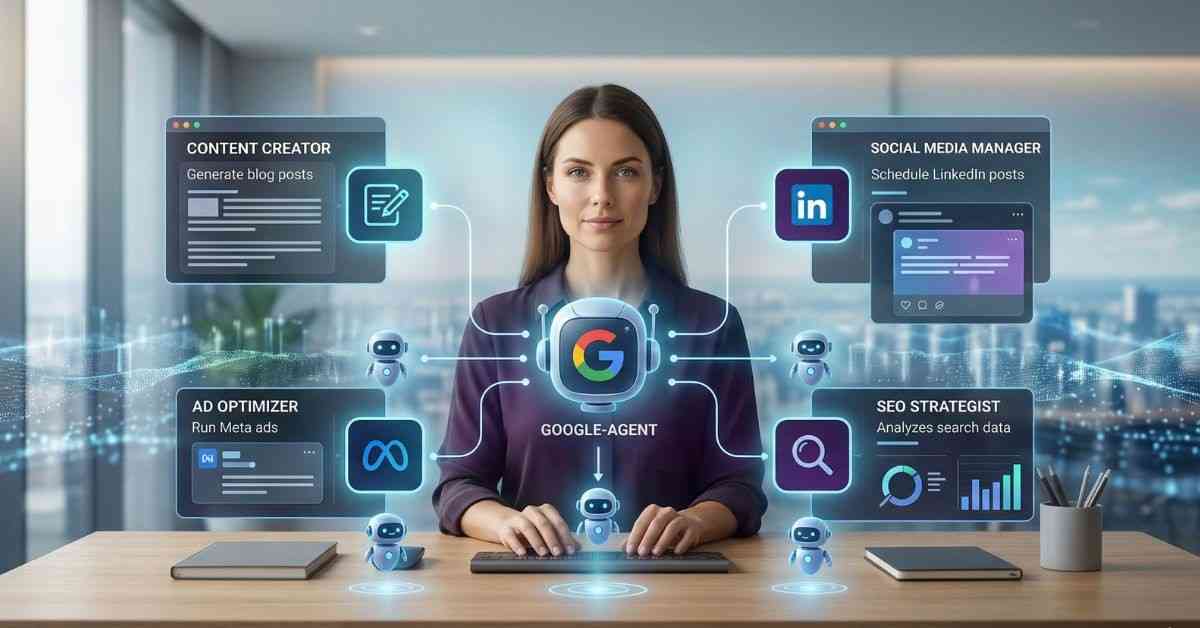
Google just quietly added something called Google-Agent to its list of official web crawlers. Most people scrolled past it. I didn’t — because I think this is one of those moments where you’re watching an industry shift in real time, and most marketers are still asleep on it.
Let me break it down in plain language — no jargon, no fluff. Just what’s actually happening and what it means for your business.
Google-Agent is a new user-triggered web crawler launched by Google. It is used by AI-powered agents hosted on Google’s infrastructure to browse the web and take actions on behalf of users. It is currently linked to Google’s Project Mariner.
Google’s own documentation says: Google-Agent is used by agents hosted on Google infrastructure to navigate the web and perform actions upon user request — for example, Project Mariner.
User-triggered means a real person initiates the action, and the agent goes out and does the work. This isn’t a passive crawler indexing pages. This is an AI that acts. Big difference.
If you haven’t heard of Project Mariner — it was Google’s early attempt at a browser-style AI assistant. You’d tell it what to do, and it’d go handle tasks on the web for you. Launched in 2025, it was available only to Google AI Ultra subscribers and select Google Labs testers.
Honestly? Early reviews weren’t kind. One tester literally called it “far from perfect.” But that’s not the story here. The story is what Google did next.
Google moved much of the Project Mariner team over to its Gemini Agent product. The computer-use capabilities built under Project Mariner are now being folded into Google’s broader agent strategy. Google itself confirmed this pivot — one day before the Google-Agent crawler went live.
A Large Action Model (LAM) is a type of AI agent that doesn’t just generate text — it takes real actions. It understands a goal, breaks it into steps, clicks buttons, calls APIs, fills forms, and completes tasks autonomously or with human oversight.
This is the distinction that most people are missing in the AI conversation right now. Everyone is talking about LLMs — Large Language Models — the chatbots that answer questions and write content. But the next wave is LAMs — Large Action Models.
Think of it this way:
The entire agent ecosystem is being built around this idea — AI that doesn’t just say things, but actually does things. Autonomously. Around the clock.
Here’s how hot this space is getting. There’s a personal AI agent framework called OpenClaw that can deploy whole teams of AI agents — one orchestrator AI handing off tasks to specialized AIs, all working together like a real team. It’s model-agnostic, meaning it can plug into Claude, Gemini, GPT, DeepSeek — whatever.
OpenAI found this so threatening (or exciting) that they hired OpenClaw’s developer, Peter Steinberger, directly.
33% – Adobe stock lost in 6 months — fear of AI-driven custom software
3GB – RAM needed to run Mistral’s new Voxtral TTS locally on a laptop
∞ – Tasks an AI agent team can handle simultaneously, 24/7
Chinese AI providers like DeepSeek, Qwen (Alibaba), and Kimi (Moonshot AI) are also fueling this boom — offering significantly cheaper model access than US providers. The cost barrier to running agents is dropping fast.
While Google is in pivot mode and OpenAI is acquiring talent, Anthropic has already shipped something most people haven’t fully processed yet — Claude Cowork.
Cowork is a desktop app (available on both macOS and Windows) that lets non-developers — I repeat, non-developers — harness the power of AI agents. You don’t need to write a single line of code. You describe the outcome, set the cadence, and Claude handles it. It connects to Slack, browses Chrome for research, opens apps on your screen when there’s no direct integration.
This matters for marketers specifically. We’ve always been the people who needed developer help to implement what we were imagining. That bottleneck is disappearing.
Yaar, seedha baat karta hoon — this is not a “future” conversation. This is happening right now, and 2026 is the year most businesses will start feeling it.
How will AI agents change digital marketing?
AI agents will automate multi-step marketing workflows end-to-end — from content creation and ad optimization to social posting and lead follow-up — reducing manual work and allowing marketers to focus on strategy, creative direction, and brand decisions.
Here’s what I see coming:
At Monk Mode Marketing, our whole philosophy is Focus hi Growth hai. Not hustle for hustle’s sake — clarity, intention, and then execution. AI agents are the most powerful “focus amplifier” that’s ever existed for a small marketing team or a solo operator.
The noise is going to get louder as every big tech company rushes to ship their agent product. Google-Agent, Gemini Agent, Claude Cowork, OpenClaw-style frameworks — there will be ten more by next quarter. Most businesses will be overwhelmed trying to keep up.
The ones who focus — who understand the fundamentals, pick the right tools for their specific workflows, and build systems instead of reacting — those are the businesses that will grow through this shift instead of getting buried by it.
Google adding Google-Agent to its crawlers isn’t just a technical update. It’s a signal. The agentic web is here. The question is: are you building for it, or still thinking about it?
At Monk Mode Marketing, we help businesses cut through the chaos and build marketing systems that actually work — with or without AI agents.